Introduction
OpsRamp can collect Alibaba Cloud billing and usage data and present it as actionable insights within Cloud Cost Insights. This enables organizations to monitor spending, analyze cost trends, and gain visibility into cloud usage across Alibaba Cloud accounts.
Alibaba Cloud Billing Overview
Alibaba Cloud exposes billing and cost information through its Billing Center and Billing / BSS APIs. These APIs provide access to detailed cost and usage data for Alibaba Cloud services. OpsRamp uses the Alibaba Cloud billing APIs to periodically collect this data and display it within the Cloud Cost Insights module for reporting and analysis.
Required Permissions in Alibaba Cloud
To allow OpsRamp to collect cost and usage data, you must create a RAM (Resource Access Management) user in Alibaba Cloud with read‑only billing access. Assign one of the following Alibaba‑managed policies to the RAM user:
AliyunBSSFullAccessAliyunBSSReadOnlyAccess
Once the RAM user is created, generate an Access Key ID and Access Key Secret. These credentials are required during integration setup in OpsRamp.
Configure Alibaba Cloud Cost Collection in OpsRamp
In OpsRamp, select the appropriate client.
Navigate to Setup → Account → Integrations.
Search for the Alibaba cloud integration.
Select the Alibaba cloud integration and add a new Alibaba cloud integration or edit an existing one.
Enter the RAM user credentials:
- Access Key ID
- Access Key Secret
In the integration configuration, open the Options tab.
Enable Collect Cost Analytics.
From the Select Site dropdown, choose the correct Alibaba Cloud site based on your account registration:
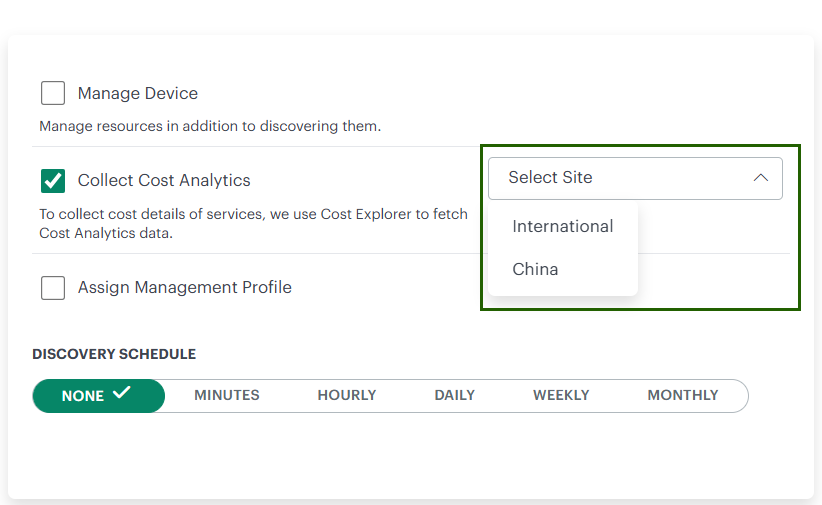
- International – For accounts registered on https://www.alibabacloud.com
- China – For accounts registered on https://www.aliyun.com
Selecting the correct site ensures that OpsRamp connects to the appropriate billing endpoint.
Save the configuration.
Once cost collection is enabled, OpsRamp begins ingesting Alibaba Cloud billing and usage data. You can analyze spending trends, service‑level costs, and overall cloud consumption.